
Security Assessment
Start with a clearer picture of where your risk actually sits.
Scope an assessment that answers a specific question about your applications, infrastructure or data, and ends in prioritised actions.
Tell us what you run. We'll help define the next step.
What we focus on
- Objectives, decisions and success criteria
- Authorised scope, method and boundaries
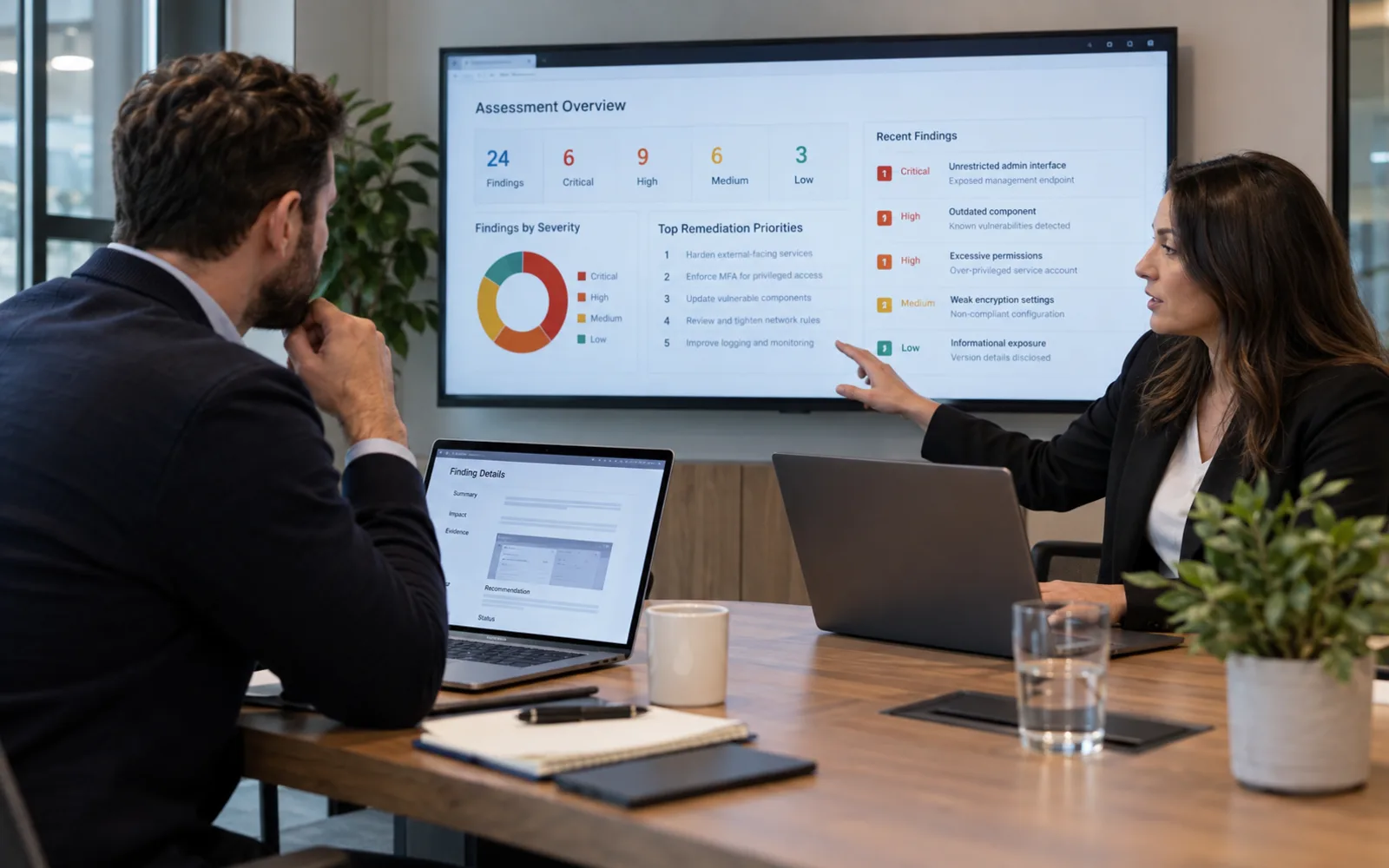
- Findings, prioritisation and next steps
- Scoped to your environment
- Clear deliverables, agreed upfront
- No account needed to enquire
Security Assessment Services
A security assessment is only as useful as the question behind it. Preparing for a launch, answering a customer security review, supporting an acquisition and deciding next year's budget are different questions, and each one changes what is worth examining and how the findings should be written. Assessments that skip this step tend to produce a long report, a colour-coded summary and very little change.
Our security assessment service is for organisations that need an independent, scoped review of applications, infrastructure, cloud environments or data handling. We agree the decision the assessment supports, define an authorised scope with explicit exclusions, document the method and constraints in writing, then deliver findings rated by real exploitability and business impact with named owners and a sensible remediation order. Anything urgent is raised as soon as it is found rather than held for the report.
Security assessment services built around a specific decision
Scope is where an assessment is won or lost. Too wide and the work skims everything and goes deep on nothing; too narrow and the finding that mattered sits one system outside the boundary. We spend the first conversation on the decision the assessment supports, because that is what tells us how wide and how deep to go.
MaxMindSecurity helps businesses scope security assessments, application security reviews, infrastructure and cloud reviews, data security assessments and risk-based prioritisation exercises. Scope, authorisation, method and reporting are agreed in writing before any testing or review activity begins.
Generic assessments produce generic results. We would rather define the decision first, keep the scope tight enough to go deep, and deliver findings that are ordered by business impact with a clear owner for each.
Best fit for
- Businesses preparing for launch, audit, acquisition or major change
- Teams needing a scoped review of applications, infrastructure or data
- Leaders who need prioritised findings rather than raw output
What you receive
- An authorised scope with clear objectives and boundaries
- Findings organised by business risk and remediation priority
- Recommended next steps with owners and sequencing
Security assessment areas we help you scope
The quality of an assessment is mostly decided before it starts. Clear objectives, an honest scope and agreed authorisation produce findings people act on; vague briefs produce reports people file.
Objectives, decisions and success criteria
We begin with the decision behind the request. An assessment supporting a product launch looks different from one supporting a customer security questionnaire, an acquisition, or a board conversation about budget. Establishing the audience and the decision determines the depth required, the systems worth examining and the way findings should be written, so the report lands with the people who need to act on it.
Authorised scope, method and boundaries
We define exactly which systems, environments, applications, accounts and data are in scope, and which are explicitly excluded. Method is agreed alongside it: configuration review, architecture review, authenticated or unauthenticated testing, or evidence-based assessment where access is limited. Testing windows, rate limits, prohibited actions, third-party permissions and escalation contacts are recorded in writing before any activity begins.
Findings, prioritisation and next steps
Findings are assessed for real exploitability and business impact rather than presented as an undifferentiated list. Each is written with the evidence behind it, the practical consequence, a recommended remediation and an owner. We also identify what is not worth fixing immediately, because a credible assessment tells you where not to spend as clearly as where to act.
A focused assessment scope agreed before work begins.
Before any review or testing activity, we agree what question the assessment answers, what may be examined, and how the results will be used.
The question and the audience
We establish what decision the assessment supports and who will read the output. A technical team fixing findings, a customer reviewing your security posture and a board approving budget need different levels of detail, and writing for the wrong audience is the most common reason a report goes unused.
Systems, environments and exclusions
We define the applications, infrastructure, cloud accounts, domains and data in scope, along with anything deliberately excluded. Where systems are hosted or operated by a third party, we confirm what permission is needed and who must authorise it before any activity touches them.
Method, authorisation and safety
We agree the method, whether configuration review, architecture review, authenticated testing or evidence-based assessment, and record the authorisation in writing. Testing windows, rate limits, prohibited actions, data handling and escalation contacts are all settled beforehand so the work carries no surprises.
Start with the right scope.
Tell us what decision the assessment needs to support, which systems or data should be examined, and any deadline involved. We will confirm the proposed scope, authorisation requirements, method, deliverables, availability and pricing before work begins.
What a security assessment engagement can include
- Agreed objectives, audience and success criteria
- Written scope with systems, environments and explicit exclusions
- Documented authorisation, method and testing constraints
- Findings with supporting evidence and practical consequence
- Risk ratings based on exploitability and business impact
- Prioritised remediation recommendations with owners
- Executive summary written for non-technical stakeholders
- Optional retest or verification of remediated findings
Request a quote for security assessment
Share the systems involved, your priorities and the tools you already use. We reply by email with the scope, availability and pricing once we have reviewed what you send.
Your enquiry is with our team.
We will review what you sent and reply to your email address. Nothing starts until scope and price are agreed in writing.
Explore services in the meantimeAn assessment that ends in decisions, not just a document.
We move from objective setting to prioritised findings in stages, so the work stays tied to the question that prompted it.
-
01
Objectives and scope
We agree the decision the assessment supports, the systems in scope, the exclusions and the audience for the findings.
-
02
Authorisation and planning
Method, testing windows, permitted actions, third-party permissions, data handling and escalation contacts are recorded before work starts.
-
03
Assessment and evidence
We carry out the agreed activity, capturing evidence as we go and raising anything urgent immediately rather than saving it for the report.
-
04
Findings and next steps
Findings are prioritised by real risk, written with recommendations and owners, and walked through with your team.
Questions teams ask before commissioning an assessment.
The most useful assessments are narrow, authorised and written for a specific reader. These answers explain how we get there.
Is this a penetration test?
It can include testing, but the term covers a range of methods. NIST SP 800-115, the Technical Guide to Information Security Testing and Assessment, groups them into review techniques such as documentation and configuration review, target identification such as discovery and scanning, and vulnerability validation such as penetration testing. Depending on the question and the access available, an assessment may use one group or all three. The method is agreed in the proposal so expectations about depth and coverage are set beforehand.
What authorisation do you need?
Written authorisation from someone able to give it for every system in scope, including anything hosted or operated by a third party, where the provider's permission may also be required. Testing windows, permitted and prohibited actions, rate limits, data handling and escalation contacts are all recorded before any activity begins.
How are findings prioritised?
By whether they are genuinely exploitable in your environment and what the business consequence would be, not by scanner severity alone. A theoretical issue on an isolated system ranks below a modest one on a path an attacker could realistically use, and the report explains the reasoning so you can challenge it.
Will you retest after we fix things?
Retesting can be included in the scope or arranged afterwards. It is worth agreeing upfront, because verification is most useful while the context is fresh and it gives you evidence that a finding is genuinely closed rather than assumed to be.
What if you find something serious during the work?
It is raised immediately through the agreed escalation contact rather than held for the report. If something is being actively exploited, that takes priority over completing the assessment, and we will help you decide on immediate containment before the remaining work continues.
Who is the report written for?
Both audiences. Findings include the technical evidence and reproduction detail your team needs to fix issues, alongside an executive summary written for non-technical stakeholders such as leadership, customers or auditors who need the overall picture without the technical detail.
Need a specific answer? Talk to our team
Further reading: NIST SP 800-115, Technical Guide to Information Security Testing and Assessment
Services that pair naturally with a security assessment.
An assessment tells you where to act. These services help you act on what it finds.