
Website security
Make security part of your website.
Practical reviews of login controls, database access and website settings for Laravel and custom websites.
Tell us what you run. We'll help define the next step.
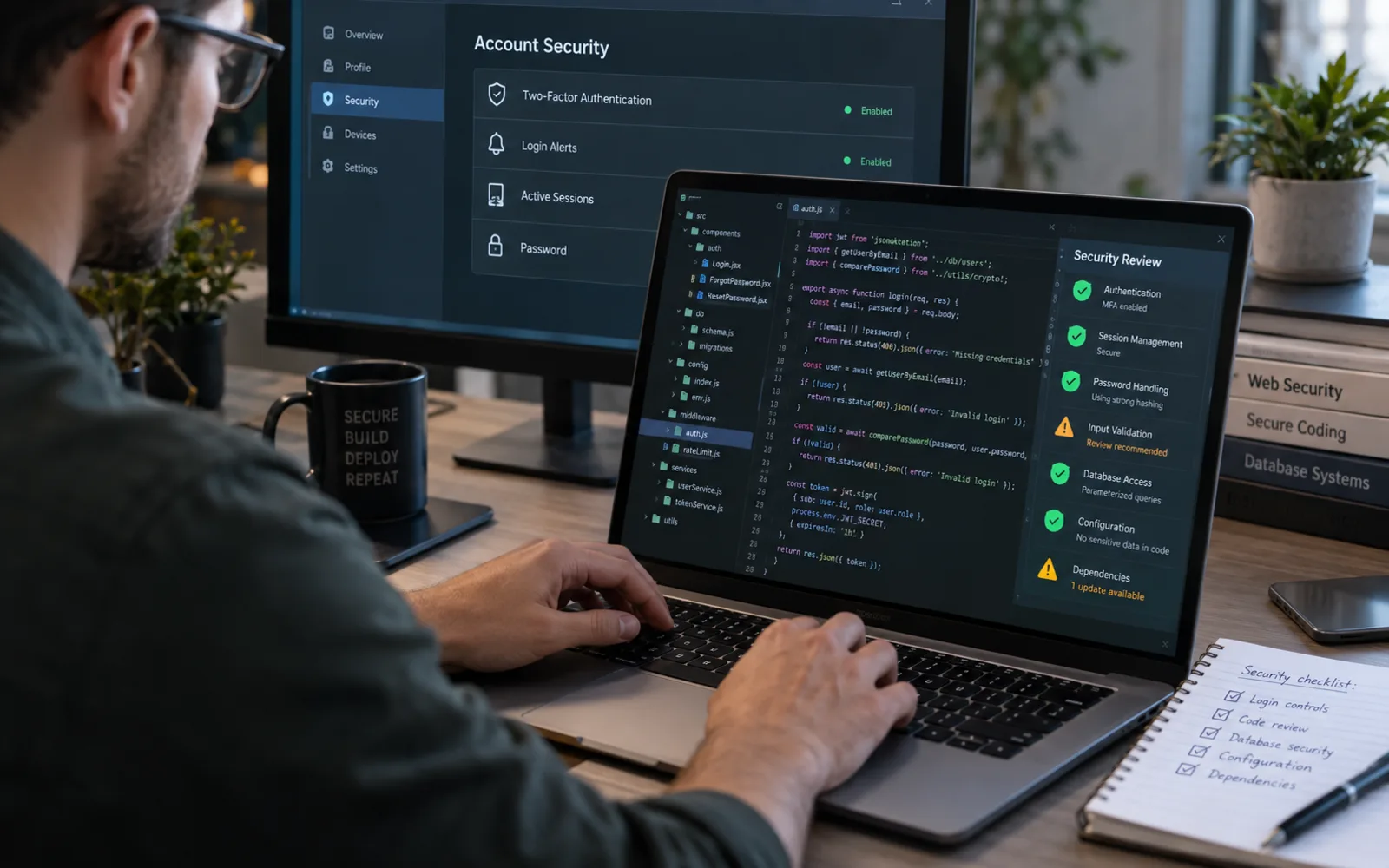
What we focus on
- Login and brute-force controls
- Database security and secret handling
- Dependencies and API access
- Scoped to your environment
- Clear deliverables, agreed upfront
- No account needed to enquire
Website Security Services
Give your website a clearer security baseline. We review the agreed website settings and access controls, helping your team prioritize issues around logins, database access and sensitive configuration.
For business websites, portals and custom websites that need security support alongside their development process. The right scope depends on the framework, hosting environment and access you can provide, so share those details during setup.
Website security for login, code, configuration and data access
A business website can look simple from the outside while relying on logins, databases, admin panels, plugins, API keys, backups and deployment scripts behind the scenes. Website security work is useful when those moving parts need a clearer baseline.
MaxMindSecurity helps teams review website login controls, brute-force protection, database access, secret handling, dependency risk, API access and backup configuration. The work is scoped around the framework, hosting environment and access your team can provide.
Good website security advice has to be practical. A small business site, a Laravel portal, a custom booking system and a content-heavy marketing site do not need the same review depth. We document what matters for the site you actually run and sequence fixes so teams can act without guessing.
Best fit for
- Business websites, portals and custom sites with login or admin access
- Laravel or custom websites that need security reviewed before launch or after change
- Teams that want practical recommendations for code, configuration and access risk
Typical outcomes
- A clearer website security baseline across access, data and configuration
- Prioritized findings your developer or hosting provider can act on
- A practical plan for remediation, backup review and incident readiness
Website security areas we help you review
Website security depends on the application, hosting environment and operational process working together. We review the points where a weakness is most likely to become business risk.
Login, admin and account controls
We review authentication flows, password reset behavior, rate limiting, administrator access, session handling and account recovery paths. The aim is to reduce common abuse without making legitimate access difficult for the people who need it.
Code, dependencies and configuration
We look at framework version, dependency exposure, configuration files, environment secrets, API keys and deployment assumptions. Findings are written so developers can understand the consequence and the practical fix.
Database, backups and response planning
We review how the website reaches its database, whether permissions are proportionate, how backups are configured and what the team would do if the site was compromised. Security is stronger when recovery is planned before it is needed.
A focused website security scope before review work begins.
Before reviewing a website, we confirm the framework, hosting, data sensitivity, access available and the decision the review needs to support.
Website type and business role
We identify whether the site is public marketing, ecommerce, a customer portal, an admin tool or a custom workflow, because those roles change the security priorities and the depth of review required.
Technical environment and access
We confirm framework, hosting, repository access, staging availability, database access boundaries, logs and who can approve changes. The access request is matched to the agreed scope.
Findings and remediation path
We produce recommendations with owners and sequence. Some fixes may belong to developers, some to hosting providers and some to account administrators, so responsibility is made explicit.
Start with the right scope.
Tell us about your environment, the assets involved and your priorities. We will discuss the scope and provide a tailored quote before you commit.
What a website security engagement can include
- Website architecture and hosting overview
- Login, account recovery and administrator access review
- Database access and secret handling review
- Dependency, API and configuration risk review
- Backup and incident-response readiness notes
- Prioritized remediation recommendations
- Quote-ready scope with technology, effort and responsibilities defined
Request a quote for website security
Share the systems involved, your priorities and the tools you already use. We reply with scope, availability and pricing, usually within one working day.
Your enquiry is with our team.
We will review what you sent and reply to your email address, usually within one working day. Nothing starts until scope and price are agreed in writing.
Explore services in the meantimeA website security review that ends in practical fixes.
We move from environment discovery to prioritized recommendations, so the output is useful for the people responsible for the site.
-
01
Environment review
We confirm the site purpose, framework, hosting, data sensitivity and access available for the agreed review.
-
02
Control review
We examine authentication, configuration, dependencies, database access, API paths and backup assumptions.
-
03
Risk prioritization
Findings are ordered by likelihood, business impact and the effort needed to fix them.
-
04
Handoff
We document owners, remediation sequence and any follow-up testing or verification that should happen.
Questions teams ask before a website security review.
Website security work is most useful when scope, access and responsibility are clear before review begins. These answers explain how we approach that.
Can you work with a framework other than Laravel?
Tell us the framework, version and hosting arrangement. We confirm the applicable service scope and access requirements before setup.
How do I get started?
Send a quote request with your requirements. We will reply by email to discuss your environment and agree the scope before any work begins.
What is the difference between the Basic, Advanced and Pro tiers?
Basic covers login and brute-force control review alongside database security and secret handling. Advanced adds dependency and vulnerability review with agreed remediation assistance. Pro extends the scope to authentication and API access control, backup configuration and incident response planning.
Will you make code changes, or only point out issues?
The scope is agreed with you. Some engagements are a review with prioritised recommendations that your development team implements; others include agreed remediation assistance, particularly at the Advanced and Pro tiers. Any change to production code or configuration is coordinated with whoever manages your deployment.
Do you need access to our database or source code?
Only the access agreed for the scope, which is confirmed before work begins. A configuration and access review does not require sensitive customer data, and any credentials or environment access needed is discussed as part of setup rather than requested upfront.
What hosting environments do you support?
Tell us your hosting arrangement, whether that is shared hosting, a VPS, a managed platform or a cloud provider, and we confirm what is achievable within that environment. Some recommendations, such as server-level changes, may need coordination with your hosting provider or IT team.
Need a specific answer? Talk to our team
Services that pair naturally with website security.
A website review often leads to edge protection, bot controls, DNS review or managed follow-up.